Staff Report #1
October 19, 2026
To All Commissioners
Re: Fall Service Update – Conventional Transit
Recommendation
The report be RECEIVED for information.
Background
2026 Service Plan Implementation – Conventional
September is traditionally the most challenging month for transit service providers as it is the time of year when service improvements are implemented to address what has been determined through the planning process as the most pressing issues on the service. Service is also adjusted back to fall levels given the return of post-secondary students. Given service improvement plans are approved nine to twelve months in advance of implementation, there is a strong possibility that new issues not contemplated in the approved plan will arise. This is also the time of year when vacations end and the shift back to school and regular routines result in increased traffic and congestion. Given buses operate on the same corridors as all other vehicular traffic, this additional congestion can result in schedule adherence issues. It is typical to take three to four weeks for travel patterns to become set for both transit riders and those driving personal vehicles. The nature and extent of road construction projects can also significantly impact travel patterns and congestion levels that were not contemplated at the time the service plan was approved. On-time performance for conventional service came in at 67% for September 2026 versus 62% in September 2025. This follows the overall trend for incremental improvement in 2026.
Effective September 6, the 2026 service plan changes were implemented which totaled an addition of 20,337 annualized service hours. The changes included the extension of Route 127 to Westmount Mall so that students in the area had a direct route to Western University that was removed with the routing modifications made to Route 10 as part of the 2025 service plan changes. Route 91 was also extended to Argyle Mall providing additional routing and capacity options between Argyle Mall and the Oxford corridor. The remainder of the changes implemented for September were focused on addressing ongoing operational concerns including the span of service and frequency. To date, feedback from the public and Operators has been minimal with regards to the changes which is generally a sign that they have been well received as passengers are more likely to call in with concerns regarding the service as opposed to complimenting improvements. In addition to the approved service hour additions, approximately 56 daily tripper hours are also being utilized on weekdays to help address crowding and reliability concerns across the system as warranted.
An integral part of the implementation of service changes is the monitoring of the impacted routes post implementation. The Planning department monitors ridership daily to determine where the most significant crowding and schedule adherence issues are being experienced. As referenced earlier in this report, each day available buses are assigned to the highest priority routes. Customer contacts and feedback from Operators are also closely monitored during the initial weeks post service change implementation in an effort to identify any areas where schedules can be adjusted for the next sign-up period to address schedule adherence or connectivity concerns noting these changes are limited to those that do not require additional service hours but rather can be accommodated through an overall schedule adjustment.
As with all service plan changes, the impact of the changes must be assessed over a twelve-to-eighteen-month period to determine if the changes were successful in managing the service concerns they were meant to address or if other changes are required. All changes implemented as part of the 2026 service plan will continue to be monitored over the coming months and should any additional modifications be necessary, they will be subject to review through the annual service planning process.
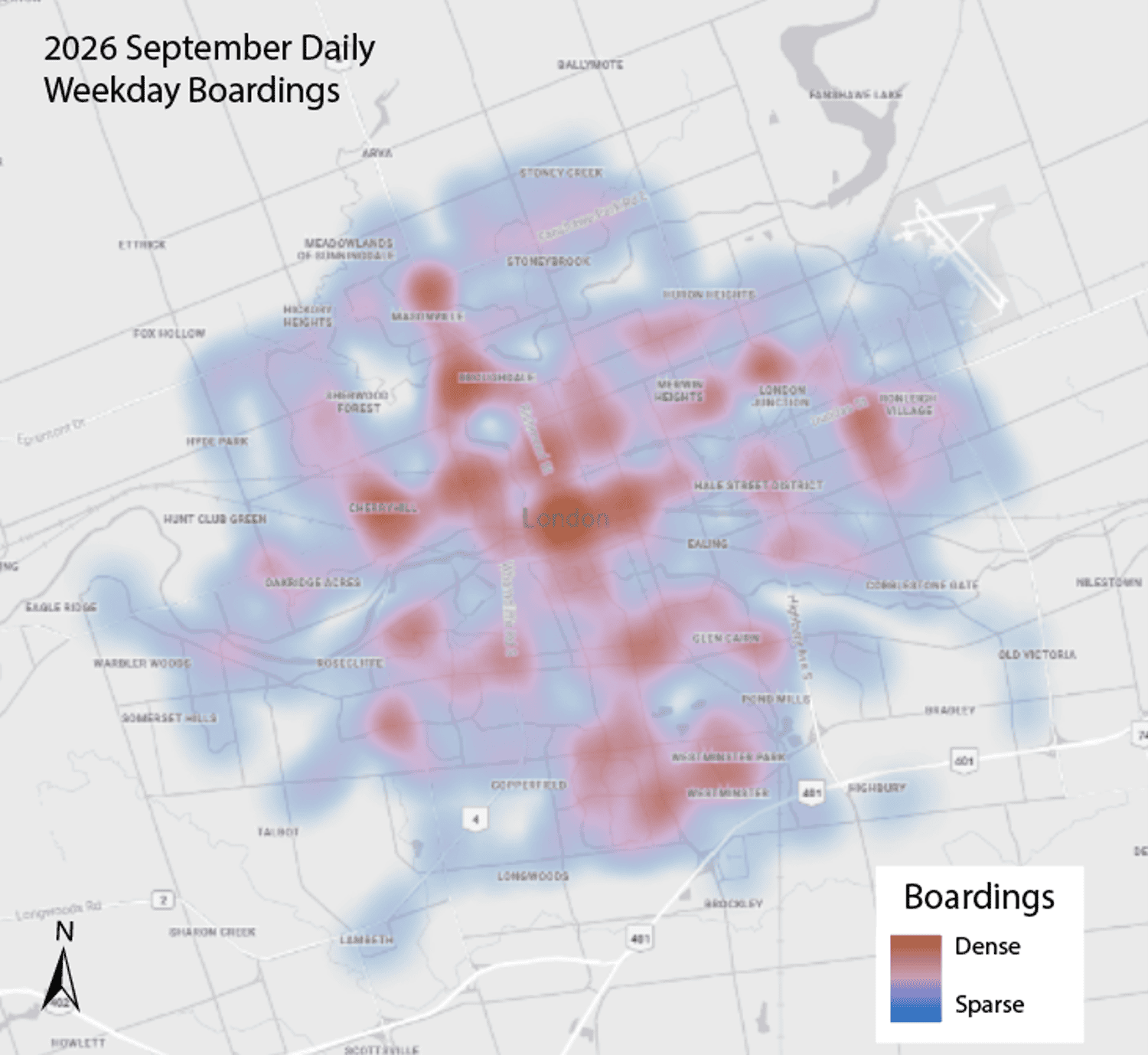
The following map depicts the areas of the City where crowding concerns have been the most prevalent during the period of September 6 through 30.
The remainder of this report provides additional detail about the various issues that have impacted on the effectiveness of the service plan changes for 2026.
External Factors Impacting Fall Service
Service has been significantly impacted by the numerous construction projects across the city, including major Rapid Transit construction along Wellington Road, Highbury and Oxford. In addition, there is significant construction impacting the Sarnia and Western Intersection. During peak periods, buses can sit as many as six light cycles before getting through the intersection which has a negative impact on schedule adherence and the reliability of the service. Nine routes travel through this intersection, with several of them being long routes travelling across the City. The delays experienced at this intersection have a cascading impact on the reliability of service along the entire route. As of September 6, a total of 37 conventional transit routes were impacted by construction projects resulting in detours and/or delays associated with lane restrictions. Administration will continue to monitor service daily and assign available buses to the areas experiencing the most difficulty maintaining schedule or accommodating ridership demand.
Secondary Student Bus Pass Pilot Program Launch
Over the past several months, LTC Administration has worked in collaboration with civic Administration and Thames Valley School Board Administration on the planning for the implementation of the Secondary Student Bus Pass Pilot Program. The multi-party agreement, which sets out the responsibilities of each of the parties has been executed.
Specific to London Transit, Administration has worked with the vendor to prepare the smart card system to allow for the acceptance and ridership tracking of the passes that will be issued to the grade 9 students at Clarke Road Secondary School in the coming weeks. Additionally, a student handout has been prepared which outlines the expectations of students relating to their use of public transit and the pass that will be provided. This information is being shared with students in conjunction with the communications from the school board, which will require parental consent for student participation in the program. Given the requirement for parental consent, the program will net get underway until consent forms have been returned and passes have been issued, which is anticipated to occur by the end of October.
Recommended by:
Katie Burns, Director of Planning
David Butler, Director of Operations – Conventional
Craig Morneau, Director of Fleet & Facilities
Mike Gregor, Director of Finance
Concurred in by:
Kelly S. Paleczny, General Manager