Staff Report #1
June 9, 2026
To All Members of the Accessible Public Transit Service Advisory Committee
Re: Accessible Conventional Transit Stops
Recommendation
That the report be RECEIVED for information.
Background
As set out in the 2026 work plan, one of the key initiatives for the year is to assess the accessibility of conventional transit bus stops to determine modifications to make them more accessible for passengers with visual impairments to use independently.
As an initial step, an industry scan was completed to assess how other transit properties within the province are addressing the issues relating to accessibility features at conventional bus stops, specifically relating to customers with visual impairments. In addition to identifying options, the review also weighed the benefits and drawbacks associated with each, based on feedback from the various properties as well as consideration as to how each option may fit in the London context. The options have been broken into three categories for consideration in London:
- Quick wins – changes that can be implemented relatively quickly with limited capital investment
- Medium to long term – options that have been fully assessed, but will take longer to implement
- Options that require further assessment
Options in each of these categories are discussed in greater detail in the remainder of this report, and feedback on each of the options will be gathered from members of APTSAC through discussion at the meeting.
Quick Wins
Relocation of Bus Stop Poles at Stops with Shelters
The general rule when waiting for a bus is to stand at or near the bus stop pole; however, the location of the bus stop pole at stops with shelters has on occasion resulted in a passenger being missed by the Operator this is due when bus stop poles are on the far side of a shelter, the shelter blocks the view of the Bus Operator, which can result in a passenger being missed.
Recommended Action: An assessment of all bus stop locations is currently underway to identify bus stop locations where the bus stop pole is located at the far side of the shelter, noting any of these locations would have the pole relocated to the nearside to improve visibility of waiting passengers.
Medium to Long Term Implementation
Standardized Bus Stop Poles
Currently, bus stops across the system can be installed on a variety of poles: U-channel, wooden hydro poles, light standards, etc. Passengers relying on a cane to detect a bus stop pole will experience difficulties when the stop sign is located on something other than the standard U-channel pole. Eliminating the placement of bus stop signs on other poles will aid in reducing confusion.
Recommended Action: An inventory of all bus stop locations that are utilizing poles other than the standard U-channel is being created. As road rehabilitation or other life-cycle maintenance projects are undertaken, new U-channel poles will be installed for the bus stop sign at these locations.
Further Assessment Required
Colour Contrast at the Curb
To help passengers more easily determine where the edge of the bus stop is located, some municipalities and transit properties are painting the curb in a contrasting colour at bus stop locations. High contrast markings allow individuals with low vision to independently discern the bus stop area. Feedback on the benefits of this approach has been mixed, noting that curbs are generally covered in snow for a significant portion of the year, which results in this feature being useless during these periods. Given this feedback, further assessment is required, noting discussions with the City of London are also required to determine if painting of the curbs at the bus stop locations would be permitted.
Recommended Action: Further assessment will be undertaken.
Directional Tactile Plates
Some transit properties have started to install directional tactile plates at bus stops as they are cane detectable and help passengers to independently navigate the bus stop location. Through the assessment, concerns from properties that are currently trialing the installation of the plates were raised with regards to winter maintenance. The tactile plates can be difficult to maintain in the winter to ensure that they are still accessible and usable to passengers when there is snow and slush on the ground. Additionally, the durability of the plates through winter maintenance measures is also in question. Directional tactile plates also have a significant cost for installation at each of the stops.
Recommended Action: Administration will continue to assess this option and gather feedback from other transit properties on the success or challenges of the installation to determine if this option is viable for London in the future.
Use of Apps to Aid Navigation
There are more and more Apps becoming available on the market that help to direct passengers in finding their bus stop location through turn-by-turn directions. Specialized Apps such as All Aboard can bridge the gap in finding the exact location of a bus stop sign, which is a common issue with standard GPS, often called “the last 10-meter problem” These tools allow users to travel without relying solely on assistance from passersby.
Real-time data and environmental awareness Apps such as NaviLens scan for codes to provide immediate information such as waiting times for upcoming buses and can also navigate the stop layout to direct passengers to the correct waiting areas, shelters, benches etc.
As with any technology there are some drawbacks to the use of technology to help guide passengers at bus stops including,
- Inaccuracy of GPS in Cities: traditional GPS systems have limitations in areas with tall building, which make finding precise bus stop locations difficult
- Last 10-Meter Problem: even with GPS, it can be difficult for a user to know exactly where to stand at a bus stop, causing them to stand too far from the sign or miss the bus
- Cost: associated costs with partnering with a specific App would need to be further investigated
- Variable Infrastructure Requirements: Some advanced Apps (e.g. NaviLens) require transit agencies to install specialized codes, which may not be universally available and can add additional cost
- Technical Issues: Reliance on technology means that issues like battery drainage, lack of cellular data or technical glitches can leave the user stranded
- Lack of Accessibility: requires passengers to download an App and have access to a smartphone with data, which not all passengers may have access to.
Recommended Action: Administration will continue to investigate whether the use of an App is a viable option within the London context.
Standardized Stop Design
In addition to the aforementioned options relating specifically to bus stop improvement options to address accessibility relating to customers with visual impairments, London Transit is also currently updating the Bus Stop Standards and Technical Guidelines Manual which includes standards for various aspects of bus stop design, planning, placement, relocation, etc.
Through the assessment process of accessibility features in other jurisdictions, one aspect that was consistently shared across transit properties, is the need to have a consistent design for bus stops, including consistency in placement of amenities, bus stop poles, etc. London Transit is looking to create standardized bus stop designs to make stops easier for all passengers to navigate. It is currently proposed that stops be broken into four categories and depending on the category of the stop, different levels of amenities etc. would be at each of the stops. The proposed stop categories are set out below.
- Standard– A standard stop is the most common stop type in the transit network. These stops are located on residential, collector, major collector, and arterial streets. Standard stops are typically served by at least one local route. Standard stops are the baseline stop classification and the only warrant is the provision of bus service at the stop location.
- Enhanced- An enhanced stop is a standard stop upgraded with a shelter. These stops are located along major collector and arterial streets. Enhanced stops are typically served by at least one local route.
- Major– A major stop is designed to accommodate a very high volume of customers. These stops are commonly applied along corridors with higher-frequency service. Major stops are primarily served by at least one Express Route. They could also be served by local routes with high ridership or observed transfer activity. Many major stops would be located at a transfer location between an express or local bus route and the future Rapid Transit service
- Rapid Transit– Rapid Transit Stations are either centre-running or curbside along the designated Rapid Transit corridors in dedicated transit lanes. These stops have the highest frequency of service and are served by at least one Rapid Transit Route. In some instances (especially in curbside locations) local and express routes will also serve the RT stations.
Depending on the stop level classification, different amenities are proposed for the stop as warranted. Table I below sets out the proposed amenities identified as Required (R), Potential Application (PA), Not Recommended (NR) to be included for each of the stop classifications
Bus Stop Amenities by Classification
| Stop Classification | ||||
| Amenity | Standard | Enhanced | Major | Rapid Transit |
| Required Amenities | ||||
| Bus Stop Sign | R | R | R | PA |
| 9m Concrete Landing Pad | R | R | NR | NR |
| 14m Concrete Landing Pad | NR | PA | R | NR |
| 20m Concrete Platform (minimum) | NR | NR | NR | R |
| Customer Comfort | ||||
| Bench | PA | PA | PA | R |
| Standard Shelter (4’x8’) | NR | R | R | NR |
| Rapid Transit shelter | NR | NR | PA | R |
| Waste Receptacles | PA | PA | PA | R |
| Customer Information | ||||
| Passenger Information Display | NR | PA | PA | R |
| Maps & Wayfinding | NR | PA | R | R |
| Safety and Security | ||||
| Security/CCTV Cameras | NR | NR | NR | R |
| Pedestrian / Stop Lighting | PA | PA | PA | R |
| Multi-Modal Integration | ||||
| Bicycle Parking | PA | PA | PA | PA |
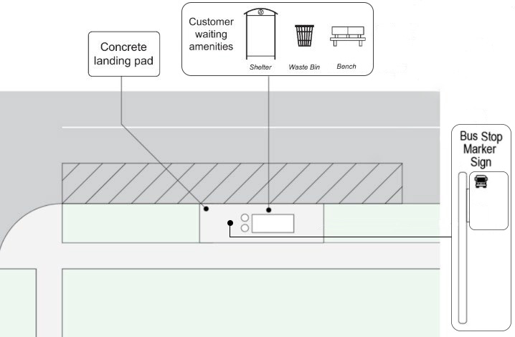
With the various amenities to be included at each of the stop classifications, determining consistent placement of bus stop poles, shelters, benches, garbage receptacles, etc. will be important to ensure as much consistency in the stop design as possible to help make it easier for the stops to be used independently by all passengers. Figure I below sets out a proposed standardized stop design for an enhanced bus stop classification, including a shelter, bench and garbage receptacles.
Figure 1 – Example of a Standardized Enhanced Bus Stop Design
Feedback received from the APSTAC Committee with respect to the elements included in the Guidelines will be incorporated into the Draft Bus Stop Standards and Technical Guidelines document, which will be presented to the Commission at a future meeting.
Next Steps
Administration is looking to the APTSAC committee to provide feedback on the above options for improving accessibility at bus stops and identify any other changes that could be made to help improve accessibility. Suggestions will be assessed and incorporated into future work plans and budgets as applicable.
Recommended by:
David Butler, Director of Operations – Conventional
Katie Burns, Director of Planning
Concurred in by:
Kelly S. Paleczny, General Manager