Accessibility Plan 2026 – 2030
TABLE OF CONTENTS
- Executive Summary
- London Transit Profile – Accessible Public Transit Services Page 1
- Methodology for Annual Update Page 2
- Removal and Prevention of Barriers Page 3
- Accessibility Initiatives Page 4
Appendix I
London Transit 2026-2030 Accessibility Work Plan
Appendix II
London Transit Accessible Customer Service Policy
Appendix III
Other London Transit Accessibility Policies
Appendix IV
Process For Managing, Evaluating And Taking Action On Customer Feedback
Appendix V
Process For Estimating The Demand For Specialized Transportation Services
Appendix VI
Steps To Reduce Wait Times For Specialized Transportation Services
Appendix VII
Procedures For Dealing With Accessibility Equipment Failures
SECTION I – EXECUTIVE SUMMARY
This report serves as a five-year plan, established in compliance with requirements in Regulation 191-11 (Integrated Accessibility Standards Regulation or IASR).
The plan sets out specific strategies to address local accessibility issues and regulatory requirements over the next five-year period, noting the two may be at odds with one another.
The plan was developed with input from the LTC’s Accessible Public Transit Service Advisory Committee, as well as consideration of input from stakeholders via an online survey, public drop in, voice of the customer survey and customer contacts.
London Transit Commission is committed to:
- the continuous development of accessible public transit services;
- working toward ensuring its facilities are barrier free;
- working toward providing barrier free employment and employment opportunities; and
- establishing communication services that respect the abilities of all customers, employees and the public at large.
The activity undertaken in previous years, and reported on annually, is reflective of the continued progress in advancing to the goal of full accessibility in service, facilities, employment and communication. The Commission’s commitment is based on making balanced, measured and sustainable progress consistent with its business planning process and financial and operational capacity.
The following report includes discussion on a number of initiatives intended to improve the accessibility of the services offered by London Transit and a corresponding work plan that addresses all regulatory requirements as established under the Accessibility for Ontarians with Disabilities Act. Linking the accessibility plan initiatives to the LTC business planning process provides the mechanism to chart progress in identifying and removing existing barriers, and safeguarding against new barriers being created and ensuring gains are sustainable.
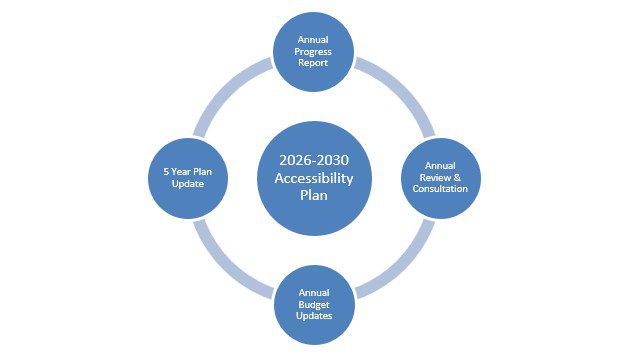
Consistent with the IASR requirements, annual public consultations will continue to be held to discuss progress toward the goal of full accessibility. Subsequent to those sessions, an annual report will be prepared and posted on the Commission’s website. The plan will be reviewed and updated at a minimum every five years.
Skylar Franke
Chair, London Transit Commission
SECTION II – LONDON TRANSIT SERVICES PROFILE
The London Transit Commission provides two public transit services; namely, conventional transit and specialized transit services. The respective profiles are as follows:
Conventional Transit Service – 2024 Service Profile
Type of service Fixed route – modified radial service
Service Area Primarily within old City of London boundaries
limited service extends into new City boundaries
Annual passenger trips 19.2 million
Fleet make-up Approved fleet size of 241 buses all of which are low floor accessible
Specialized Transit Services – 2024 Service Profile
Type of Service Shared Ride – Door to Door – Pre-Booked
Service
Registrants are able to book trips three days in advance. Trips, with the exception of subscription trips, are awarded on a first come first serve basis. There is not a guarantee of trip availability.
Service Area Within new City of London boundaries (i.e. includes the annexed areas)
Registrants 9,214
Annual passenger trips 310,800
Fleet requirements Fleet requirements are provided via contract, current fleet size during peak operating periods is 56 lift-equipped vehicles.
SECTION III – METHODOLOGY FOR ANNUAL UPDATE
Annual Plan Update
The Accessibility Plan covers the period of 2026 – 2030, consistent with requirements in the Integrated Accessibility Standards Regulation (IASR). The plan was prepared in consultation with the Accessible Public Transit Service Advisory Committee and adopted by the Commission.
Consistent with IASR requirements, progress against the plan will be reported annually and made available to the public. The annual update will provide commentary with respect to the items included in the Accessibility Work Plan set out in Appendix I that have been scheduled to be addressed in the previous calendar year. Further, the Commission’s Accessibility Plan will be included on the agenda for an annual public meeting(s), consistent with IASR requirements. The plan will be updated as required, but at a minimum of every five years. The following diagram depicts the process.
The key inputs to the plan and related annual update are:
- legislative requirements
- customer feedback including annual public consultations and market surveys
- Accessible Public Transit Service Advisory Committee
The LTC Accessibility Plan feeds directly in to the LTC overall Business Plan Process as well as annual operating and capital budgets.
SECTION IV – REMOVAL AND PREVENTION OF BARRIERS
Consistent with requirements set out in the Accessibility for Ontarians with Disabilities Act legislation, all Commission policies underwent a review with respect to ensuring none contained language or aspects that could create barriers to accessibility. Further, the requirements in each section of the Integrated Accessibility Standards Regulation are reviewed annually in conjunction with all programs to ensure the removal and prevention of barriers is considered during program implementation.
Known Barriers
Barriers that are known are identified as part of the accessibility plan update process and, where appropriate, initiatives are included in the plan to address same. An example of a known barrier would be the lack of connecting sidewalk infrastructure to new bus stop locations. Conventional transit service has grown over the past number of years, in some cases, to new areas of the city where sidewalk infrastructure has not been built. In an effort to mitigate these barriers in a timely manner, London Transit provides a list of all transit stops that are lacking a connection to sidewalk infrastructure to the City of London for inclusion in their plans for sidewalk infrastructure.
New or Unknown Barriers
In the event that a barrier that has not been included in the Accessibility Plan is brought to the attention of LTC, it is assessed in terms of steps required to eliminate the barrier and the resources required for same. In many cases, the barrier is addressed immediately and reported on as part of the annual accessibility update. An example of this type of scenario would be a door at a London Transit facility that was not equipped with an accessibility button. When this issue was brought to the attention of LTC, it was rectified within a week.
In cases where the barrier has been assessed to be technically compliant with current regulations, but still requiring attention, it is scheduled for inclusion in the next Accessibility Plan update. An example of this type of scenario would be the counter at the downtown ticket office not being wheelchair accessible. The regulatory requirements associated with this type of accommodation are required when a major retrofit is undertaken at the facility in question, with an alternate option to allow those customers that cannot access the window to interact with ticket agents. This issue has been included in the Accessibility Plan to be addressed at such time that a retrofit is undertaken at the ticket office, and until then, ticket agents come to the other side of the window to assist customers that cannot access the counter.
SECTION V – ACCESSIBILITY INITIATIVES
Summary of Accessibility Work Plan Initiatives
The following provides a detailed description of each of the initiatives included in the Accessibility Plan, broken down by section of the Integrated Accessibility Standards Regulation.
General Requirements
- Accessibility for Ontarians with Disabilities Act (AODA) – Standard Review and Development
Throughout the AODA standard setting and review processes, the transit industry at large and London Transit administration have participated to various degrees.
LTC administration will continue to be involved in any activities relating to the AODA to the extent opportunities remain available.
- Ensuring Compliance with the Accessibility for Ontarians with Disabilities Act (AODA)
Ensuring Compliance with AODA Regulations and Supporting Standards – administration will continue to monitor any changes to regulations, as well as respond to inquiries with respect to compliance with the AODA. Additionally, administration will participate in any desk audits undertaken by the Ministry of Seniors and Disability relating to compliance monitoring. It should be noted that London Transit was subject of a desk audit earlier in 2025, the result of which confirmed no compliance issues.
- Employee Training Material Review
The training materials relating to the AODA are reviewed and updated as needed in response to specific issues or legislative changes.
Initiative: In addition to regular reviews indicated above, this initiative is intended to undertake a comprehensive review of the entire training framework for London Transit employees as it relates to the AODA, and to identify best practices in both content and delivery, and incorporate same going forward.
Information and Communications
- Consult with Advisory Committee on Marketing and Communication Plans
The Commission is undertaking a review of the manner in which public communications are undertaken and the various mediums utilized. This review will include discussion with the Accessible Public Transit Service Advisory Committee to ensure accessibility considerations are included.
Initiative: Ensure that development of the action plan relating to increased marketing and enhanced corporate communication include consultation with the Accessible Public Transit Service Advisory Committee.
Customer Service
- Implement new Standards resulting from the Mandatory Review
In 2025, changes to the Customer Service Standards were shared publicly for comment. London Transit provided commentary with respect to a number of recommended changes (feedback process, requests for documents, use of service animals and use of support persons), noting significant concerns were raised with respect to compliance implications for a number of the proposed changes.
Initiative: Administration will continue to monitor progress on finalizing the updated standards, identify the measures required to achieve compliance, and provide reports on compliance implications as appropriate.
Employment
- Review of Employment Accommodation Program
London Transit’s Employment Accommodation Program is reviewed and updated as needed in response to specific issues or legislative changes and in order to continue to ensure compliance with the AODA.
Initiative: In addition to regular reviews indicated above, this initiative is intended to undertake a comprehensive review of the entire program for London Transit employees to identify best practices in both content and delivery, and incorporate same going forward.
Conventional Transit
- Assessment of Conventional Transit Bus Stop Design
While conventional transit bus stops currently incorporate features to ensure accessibility, there have been issues identified in some stop locations with the surface area at the back door of the bus being difficult to traverse. As part of this assessment, consideration will be given to whether there should be a cement pad at the rear-door exit of the bus to ensure a flat and secure location for those leaving the bus via the rear door. The assessment will also consider any other features that are identified as best practices.
Initiative: Undertake an industry scan of bus stop design in other Ontario jurisdictions to identify any changes to design features that may be incorporated going forward.
- Accessible Transit Stops and Connecting Sidewalks
When transit stops are added or relocated, they are accessible noting each includes a cement pad to accommodate the ramp on the low-floor buses. Given the significant increase in transit stop locations over the past few years in growing areas of the city, there are currently approximately 143 conventional service stops that have cement pads, but no connecting sidewalks. Administration shares a list of these stop locations with the City of London to ensure these locations are included as priority in their sidewalk program.
Initiative: Provide the City of London, on an annual basis, a list of transit stops with no connecting sidewalks for inclusion in their sidewalk program.
- Assessment of Multi-Use Stop Procedures
Issues relating to the functionality of multi-use stops resulted in this review being placed on the previous Accessibility Plan. The primary concern relates to customers with visual disabilities who rely on the external announcement to identify the bus they wish to board. There are a number of stops, primarily in the core, that are utilized by multiple routes, which have caused challenges in the past. A number of initiatives have been undertaken in an effort to address these concerns, including the following:
- reminders to all London Transit Operators that they must pull up, stop and open their doors at the front-most position of the multi-use stop in order to ensure that customers waiting at the stop can hear the external announcement
- splitting one of the multi-use stops in the core to two locations, which reduces the number of buses utilizing each of the stops, and reduces the queuing of buses and the wait times associated with each bus pulling up to and stopping at the stop location
While these efforts have reduced the number of issues at multi-use stops, there are still instances where customers experience difficulty.
Initiative: Administration will continue to assess options in use in other jurisdictions to address this issue and will work with The Accessible Public Transit Service Advisory Committee to identify ways in which new options can be implemented.
- Assessment of Integrated Services
An important initiative, which will in part address the demand on the specialized service is the assessment and implementation of programs intended to integrate the conventional and specialized services. Various programs are in place across the province that see the two systems being utilized together in an effort to increase the availability of service in the community. This initiative will include consideration of the role that alternative service delivery models may play in increasing the availability of accessible public transit services to difficult to serve areas. This initiative was included on the previous Accessibility Plan, however was placed on hold due to the impacts of the global pandemic.
Initiative: Consult the Accessible Public Transit Service Advisory Committee with respect to initiatives under consideration as part of the Integrated Services program.
- Rapid Transit Station Accessibility Review
Concerns have been raised with respect to the newly implemented rapid transit station configurations, and the lack of clear delineation of where customers should stand to board the bus. As discussed in an earlier bullet, LTC Operators will pull up to the front-most position at the station for boarding and alighting. Unlike the multi-use stops, the rapid transit stations do not have a bus stop pole to identify this location to customers with visual disabilities. As an interim measure, temporary stop poles and signage has been installed at these stations at the location where the buses will stop and allow customers to board.
Initiative: Administration will work with The Accessible Public Transit Service Advisory Committee to identify more permanent solutions to this issue which will be shared with the City of London for consideration (noting the City of London is the owner of these stations).
- Ongoing Communications Regarding Trending Issues
Feedback from stakeholders continues to be an integral input into ongoing communication programs both internally for employees and externally for riders. Each year, Annual Customer Service reports are compiled which provide a snapshot of the customer contacts, service performance, motor vehicle incidents, etc. over the previous year, and identify trends that may be addressed by a communication campaign. Examples of this in the past include; reminders to Operators to make sure customers are seated prior to leaving the stop; on-board signage reminding riders of the expectations around the priority and courtesy seating areas on conventional buses and that not all disabilities are visible; and reminders to customers to request ramp deployment if required as the Operator doesn’t always know whether it is needed.
Initiative: Administration will continue the practice of preparing the Annual Customer Service reports for both the conventional and specialized services, and will identify areas of priority to be addressed going forward, which can include issues that would benefit from a specific communication campaign.
- Annual Customer Surveys
Stakeholder feedback continues to be one of the best mechanisms to identify areas for potential improvement in the services London Transit provides. This includes the identification of areas where the accessibility of the service could be improved.
Initiative: Undertake annual customer satisfaction surveys and include initiatives to address any concerns/trends that are identified to address accessibility related issues.
Specialized Transit
- Assessment of Demand for Specialized Service
Notwithstanding the significant investments in additional service over the past five years, the service continues to experience periods when the demand for service is greater than what is available.
Initiative: Undertake an assessment of the periods of highest non-accommodated on the specialized service to identify areas that would see the additional service hours best utilized, including consultation with local program providers to identify high-demand periods when service levels require enhancement. Consult with Accessible Public Transit Service Advisory Committee on the implementation of additional hours on the specialized service included in annual budgets, noting the conventional transit service planning process includes presentation to the Committee as well as a number of opportunities for feedback to be provided.
- Assess Impacts of a Shorter Booking Window
Feedback has been received via the 2024-2027 Business Planning process and recent Voice of the Customer surveys which identified a desire by some to move to a shorter booking window for the specialized service (current booking window is three days in advance). It is recognized that a move of this nature is not simple, and could have impacts on many areas of the specialized service and as such, the recommended path forward is to undertake a detailed assessment prior to making any changes.
Initiative: Undertake an assessment of the impacts and issues associated with a move to a shorter booking window. This assessment would include customer consultation, assessment of practices in other Ontario jurisdictions and feedback from the Accessible Public Transit Service Advisory Committee.
- Specialized Service Policy and Procedure Review
This initiative calls for a review of the current policies and procedures which guide the delivery of the specialized service. This initiative will span the period of the Accessibility Plan as individual (or related) policies will be selected for review each year in consultation with The Accessible Public Transit Service Advisory Committee. Examples of policies that will be reviewed include:
- Balance of trips between subscription, on-demand, and same day
- Trip Cancellation Policy and Procedures
- Trip No-Show Policy and Procedures
- Packages on board and assistance with same
- Transport of carts/buggies
Initiative: Administration will work with The Accessible Public Transit Service Advisory Committee to prioritize and subsequently review policies and procedures against other transit providers in an effort to identify and implement best practices where they are identified while continuing to ensure compliance with the AODA.
- Eligibility Review including Application
During consultation on the 2024-2027 Business Plan, a review of the current Eligibility Criteria and related application form were identified as an initiative for the 2026-2030 Accessibility Plan. Similar to the policy and procedure review, this would entail a review of practices at other transit providers in an effort to identify and implement best practices, while continuing to ensure compliance with the AODA.
Initiative: Administration will secure a consultant to undertake a review of best practices at other Ontario transit systems, which would include recommendations for implementation in London. Report recommendations would be shared with The Accessible Public Transit Service Advisory Committee as well as the general public for consideration prior to any changes being implemented.
- Enhanced Communication Options for Specialized Service Registrants
During consultation for the 2024-2027 Business Plan, suggestions were received with respect to enhancing methods of communication with registrants of the specialized service beyond those currently in place (on-board posters, messages on booking line, community posters, corporate website, direct mail).
Initiative: Administration will undertake a scan of specialized service providers to identify other methods that are in use for communication with specialized service registrants. The assessment will include consideration of utilizing email to provide registrants with service updates, noting any solution would have to ensure compliance with privacy legislation (PIPEDA).
- Assessment of Specialized Service Fleet Options
In order to ensure that the amount of service being provided is maximized within the available budget, an assessment of the fleet of vehicles utilized to provide the specialized service will be undertaken. As experienced in 2024/25, careful consideration and assessment needs to be undertaken when considering any vehicle for use on this service. The Pro-Master vehicles that were introduced into the fleet in an effort to continue to expand services in light of supply chain issues, have proven to be problematic for a large percentage of the registrant base due to boarding/alighting issues, and as such, has been limited to the customers it is able to serve.
Initiative: An assessment of fleet make up at other specialized transit providers, as well as the manner in which trips are assigned to various vehicle types will be undertaken. This assessment will include the impacts on the registrant base in terms of equal access to trips, and will also consider the cost per trip of each of the options being considered. Any recommendations for fleet diversification would be discussed with THE ACCESSIBLE PUBLIC TRANSIT SERVICE ADVISORY COMMITTEE prior to recommendations being forwarded to the Commission for approval.
- Annual Customer Surveys
Stakeholder feedback continues to be one of the best mechanisms to identify areas for potential improvement in the services London Transit provides. This includes the identification of areas where the accessibility of the service could be improved.
Initiative: Undertake annual customer satisfaction surveys and include initiatives to address any concerns/trends that are identified to address accessibility related issues.
Public Spaces
- Include Accessibility Lens for all Major Retrofits
All requirements relating to the public spaces in operation by London Transit are compliant, noting that, in some cases, the requirement does not require retrofit but rather are tied to major renovations. The detailed design phase of the Highbury facility rebuild project is scheduled to begin in 2026, and this will include a review of the design concepts against current accessibility standards as well as the City of London Facility Accessibility Design Standard.
Initiative: Continue to ensure that all major retrofits are assessed to ensure the removal of any existing barriers is considered a priority piece of the project.
APPENDIX I
LONDON TRANSIT 2026-2030 ACCESSIBILITY WORK PLAN
| Initiative | 2026 | 2027 | 2028 | 2029 | 2030 |
| General Requirements | |||||
| 1. Participate in Standard Reviews and Development as applicable | X | X | X | X | X |
| 2. Ensure compliance with all AODA requirements | X | X | X | X | X |
| 3. Review Employee Training Program to incorporate best practices | X | X | |||
| Information & Communications Requirements | |||||
| 4. Consult with Advisory Committee on marketing and communication initiatives | X | X | X | X | X |
| Customer Service | |||||
| 5. Assess & Implement standards resulting from recent review | X | X | |||
| Employment | |||||
| 6. Review of Employee Accommodation Program to incorporate best practices | X | X | |||
| Public Transit Service General | |||||
| Ensure compliance with all AODA requirements | X | X | X | X | X |
| Conventional Transit Service | |||||
| 7. Assessment of Bus Stop Design | X | ||||
| 8. Ensure Bus Stops have Connecting Sidewalks | X | X | X | X | X |
| 9. Assessment of Multi-Use Stop Procedures | X | ||||
| 10. Assessment of Integrated Service Options | X | ||||
| 11. Review of Rapid Transit Stations with respect to Wayfinding and Boarding | X | ||||
| 12. Ongoing Communications Regarding Trending Issues | X | X | X | X | X |
| 13. Undertake Annual Customer Surveys | X | X | X | X | X |
| Specialized Transit Service | |||||
| 14. Assessment of Demand for Specialized Services | X | X | X | X | X |
| 15. Assessment of Booking Window Options | X | ||||
| 16. Review of Specialized Transit Policies & Procedures to incorporate best practice | X | ||||
| 17. Review of Eligibility Criteria and Related Assessment Process | X | ||||
| 18. Assess Options for Enhanced Communications with Registrants | X | ||||
| 19. Assess Fleet Options for Specialized Service | X | ||||
| 20. Undertake Annual Customer Surveys | X | X | X | X | X |
| Public Spaces | |||||
| 21. Ensure that all major retrofits include removal of existing barriers | X | X | X | X | X |
APPENDIX II
LONDON TRANSIT ACCESSIBLE CUSTOMER SERVICE POLICY
Contents
- Purpose / Background Information
- Application
- Definitions
- Policy Statement
- General Principles
- The Provision of Goods and Services to Persons with Disabilities
- Communication with Persons with Disabilities
- Notice of Temporary Disruptions in Services and Facilities
- Assistive Devices and other Measures that Assist with Accessibility
- Service Animals
- Support Persons
- Feedback
- Training
- Availability and Format of Documents Required by the Accessibility Standards for Customer Service (Ontario Regulation 429/07)
- Notice of the Availability of Documents
- Training of Agents
- Supporting or Linked Policy/Procedure Documents
- Link to Other AODA Standards
Accessible Customer Service Policy
1. Purpose / Background Information
The Accessibility for Ontarians with Disabilities Act, 2005 (the “AODA”) is a Provincial Act with the purpose of developing, implementing and enforcing accessibility standards in order to achieve accessibility for persons with disabilities with respect to goods, services, facilities, accommodation, employment, buildings, structures and premises.
Under the AODA, Ontario Regulation 429/07 entitled “Accessibility Standards for Customer Service” came into force on January 1, 2008. That Regulation establishes accessibility standards specific to customer service for public sector organizations and other persons or organizations that provide goods and services to members of the public or other third parties.
This policy is drafted in accordance with the Accessibility Standards for Customer Service (Ontario Regulation 429/07) and addresses the following:
- the provision of goods and services to persons with disabilities;
- the use of assistive devices by persons with disabilities;
- the use of service animals by persons with disabilities;
- the use of support persons by persons with disabilities;
- notice of temporary disruptions in services and facilities;
- training;
- customer feedback regarding the provision of goods and services to persons with disabilities; and
- notice of availability and format of documents.
2. Application
This policy applies to all persons who deal with the public and those specifically designated, by contract to act, from time to time, on behalf of the London Transit Commission. This includes persons who are employees (full time, part time and/or on contract) and Members of the Commission and the Commission’s Accessible Public Transit Service Advisory Committee.
3. Definitions
Assistive Device
A device used to assist persons with disabilities in carrying out activities or in accessing the services of persons or organizations covered by the Customer Service Standard.
Commission
The London Transit Commission
Disability
Disability, defined to include:
- any degree of physical disability, infirmity, malformation or disfigurement that is caused by bodily injury, birth defect or illness and, without limiting the generality of the foregoing, includes diabetes mellitus, epilepsy, a brain injury, any degree of paralysis, amputation, lack of physical co-ordination, blindness or visual impediment, deafness or hearing impediment, muteness or speech impediment, or physical reliance on a guide dog or other animal or on a wheelchair or other remedial appliance or device,
- a condition of mental impairment or a developmental disability,
- a learning disability, or a dysfunction in one or more of the processes involved in understanding or using symbols or spoken language,
- a mental disorder, or
- an injury or disability for which benefits were claimed or received under the insurance plan established under the Workplace Safety and Insurance Act, 1997.
Nurse
A Registered Nurse or Registered Practical Nurse who is a registered member in good standing with the College of Nurses of Ontario.
Physician
A physician who is a registered member, in good standing, with the College of Physicians and Surgeons of Ontario.
Service Animal
An animal is a service animal for a person with a disability if,
- the animal can be readily identified as one that is being used by the person for reasons relating to the person’s disability, as a result of visual indicators such as the vest or harness worn by the animal; or
- the person provides documentation from one of the following regulated health professionals confirming that the person requires the animal for reasons relating to the disability:
- A member of the College of Audiologists and Speech-Language Pathologists of Ontario.
- A member of the College of Chiropractors of Ontario.
- A member of the College of Nurses of Ontario.
- A member of the College of Occupational Therapists of Ontario.
- A member of the College of Optometrists of Ontario.
- A member of the College of Physicians and Surgeons of Ontario.
- A member of the College of Physiotherapists of Ontario.
- A member of the College of Psychologists of Ontario.
- A member of the College of Registered Psychotherapists and Registered Mental Health Therapists of Ontario.
Support Person
In relation to a person with a disability, another person who accompanies the person with a disability in order to help with communication, mobility, personal care or medical needs or with access to goods, services or facilities
4. Policy Statement
The London Transit Commission is committed to continuing to build, for all customers, an effective, efficient fully accessible public transit service
5. General Principles
a. The Provision of Goods and Services to Persons with Disabilities
The Commission will use reasonable efforts to ensure that its policies, practices and procedures are consistent with the following principles:
- the Commission’s services are provided in a manner that respects the dignity and independence of persons with disabilities;
- the provision of the Commission’s services to persons with disabilities are to be integrated with those provided to persons who do not have disabilities unless an alternative measure is necessary to enable a person with a disability to obtain, use or benefit from the Commission’s services and,
- persons with disabilities are given opportunities equivalent to that of persons without disabilities to obtain, use or benefit from the Commission’s services.
b. Communication with Persons with Disabilities
When communicating with a person with a disability, the Commission will do so in a manner that takes into account the person’s disability.
c. Notice of Temporary Disruptions in Services and Facilities
The Commission is aware that the operation of its services is important to the public. However, temporary disruptions in the Commission’s services and facilities may occur due to reasons that may or may not be within the Commission’s control or knowledge. Reference to services includes both “on-road” services as well as ancillary services supporting the on-road service.
For the purpose of this policy statement, a “temporary disruption of service” is defined as a known or planned event that results in a deviation in regular service routing and/or schedule for an extended period of time, generally beyond one day. The known or planned nature of the event affords the Commission the opportunity to affect a revised service routing and/or schedule and provide timely communication to its customers.
The communication will include a reason for the disruption, the anticipated duration and a description of the alternative/amended routing and/or schedule as may be applicable. Such information will be provided from a menu of options, selected at the time as appropriate in the circumstances, giving consideration to time and duration. The options include:
- various news media (radio, paper, television)
- Commission website and social media
- LTC Real-Time Information
- Commission Customer Service Staff; and
- posting of the appropriate notice either/or on-board the buses and at the affected bus stops
For all other occurrences of service disruption, the Commission, as considered appropriate in the circumstances, will make reasonable effort to advise the public of the disruption including information about the reason for the disruption, its anticipated duration, and a description of alternative/amended service if any, that may be available.
d. Assistive Devices and other Measures that Assist with Accessibility
A person with a disability is to provide their own assistive device for the purpose of obtaining, using and benefiting from the Commission’s services. Exceptions may occur in situations where the Commission has determined that the assistive device (example segways) may pose a risk to the health and safety of a person with a disability or the health and safety of others on the services and/or at the premises.
In these situations and others, the Commission may offer a person with a disability other reasonable measures to assist them in obtaining, using and benefiting from the Commission’s services, where the Commission has such other measures available. This includes having the person leave the assistive devices and sit in a passenger seat in the vehicle.
Persons with a disability are responsible to ensure their assistive device is operated in a safe and controlled manner at all times in accessing Commission services.This includes setting the brakes as appropriate on manual assistive devices (wheelchairs) or in the case of power assistive devices (chair or scooter) switching the power off.
Bus Operators are responsible for ensuring that wheeled mobility devices are properly secured, complete with the appropriate tie-downs and restraining devices and securely fastened before moving the bus. Should the passenger refuse to have his or her mobility device secured, the Operator will advise that it is mandatory for safety reasons. If the problem persists, the Operator will contact Dispatch and request assistance from an Inspector.
In the event that the passenger is traveling with an attendant who wishes to secure the mobility device the Operator must check to ensure the devices have been properly secured.
e. Service Animals
Service animals are permitted on the services and/or enter premises owned and operated, or operated by the Commission, noting such permission may be subject to presentation of the appropriate identification by the owner.
Service animals are permitted on buses if working in aid of the person making the trip.
Service animals on buses must remain in the care and control of the owner at all times. The owner must be prepared to demonstrate to the Operator how this requirement will be achieved (i.e. leash, cage, etc.).
This applies as follows:
- the animal can be readily identified as one that is being used by the person for reasons relating to the person’s disability, as a result of visual indicators such as the vest or harness worn by the animal; or
- the customer provides documentation from a health professional confirming that the person requires the animal for reasons relating to the disability.
f. Support Persons
A person with a disability may utilize the services and/or enter premises owned and operated, or operated, by the Commission with a support person and have access to the support person while on the service and/or on the premises.
The Commission may require a person with a disability to be accompanied by a support person while on the service and/or on the Commission premises in situations where, in the opinion of the Commission it is necessary to protect the health and safety of the person with a disability or the health and safety of others on the premises.
A support person, when assisting a person with a disability to use the Commission services, will be subject to the prevailing fare as defined in the Commission’s fare policy, associated with the use of the services, noting the Commission’s fare policy is subject to amendments from time to time.
g. Feedback
The Commission as provided by its’ mission statement is committed:
To develop and maintain an effective, efficient and safe public transit service operating as a key component of a sustainable transportation system while being competitive, customer focused and financially responsible and providing a work environment that fosters accountability, pride, teamwork and job satisfaction.
Feedback from the public is welcomed as it may identify areas that require change and encourage continuous service improvements. Feedback from a member of the public about the delivery of goods and services to persons with disabilities may be given by telephone, in person, in writing, in electronic format or through other methods.
Information about the feedback process will be readily available to the public and notice of the process will be posted on the Commission’s website (www.londontransit.ca) and/or in other appropriate locations.
h. Training
The Commission will ensure that all persons to whom this policy applies receive training as required by the Accessibility Standards for Customer Service. The amount and format of training given will be tailored to suit each person’s interactions with the public and their involvement in the development of policies, procedures and practices pertaining to the provision of goods and services.
The content of the training will include:
- a review of the purposes of the AODA;
- the requirements of the Accessibility Standards for Customer Service (Ontario Regulation 429 / 07);
- instruction on the Commission policies, procedures and practices pertaining to the provision of goods and services to persons with disabilities;
- how to interact and communicate with persons with various types of disabilities;
- what to do if a person with a particular type of disability is having difficulty accessing the Commission services;
- how to interact with persons with disabilities who use assistive devices or who require the assistance of a support person or service animal; and
- information about the equipment or devices available on the Commission premises that may help with the provision of the services to persons with disabilities.
Timeline for Training
The various training requirements are addressed through a variety of programs/initiatives using a variety of training approaches. Such training has and/or is provided as soon as reasonably practicable based upon an individual being assigned the applicable duties as well as on an ongoing basis as changes occur to the applicable Commission policies, procedures and practices governing the provision of services to persons with disabilities.
Records of Training
The Commission will keep records of the training, including the date on which training is provided and the number of individuals to whom it is provided. The names of individuals trained will be recorded for training administration purposes, subject to the Municipal Freedom of Information and Protection of Privacy Act (“MFIPPA”).
- Availability and Format of Documents Required by the Accessibility Standards for Customer Service (Ontario Regulation 429/07)
Recognizing its responsibility under various Federal and Provincial legislation, and the Commission’s intent to fulfill its mandate in an open and accessible manner, the Commission supports the principles with respect to freedom of access to information and protection of personal information, as defined in the National Standard of Canada Model Code for the Protection of Personal Information (Can/CSA 830-96). The principles cover the areas of:
- Accountability
- Identifying purposes of collection
- Obtaining consent
- Limiting collection to the purposes required
- Limiting use, disclosure and retention of personal information to that reasonably related to the stated purpose of collection
- Accuracy in collecting and maintaining records
- Safeguarding the information collected
- Being open
- Providing individual access
- Addressing challenges regarding compliance.
Further the Commission designates the General Manager as being accountable on behalf of the Commission for the implementation of these principles in all aspects of the Commission’s functions.
All documents required by the Accessibility Standards for Customer Service, including the Commission’s Accessible Customer Service policies, procedures and practices, notices of temporary disruptions, training records, and written feedback process are available upon request, subject to MFIPPA.
When providing a document to a person with a disability, the Commission will provide the document, or the information contained in the document, in a format that takes the person’s disability into account.
- Notice of the Availability of Documents
Notice of the availability of all documents required by the Accessibility Standards for Customer Service will be posted on the Commission’s website, and available through the General Manager’s office.
- Training of Agents
Responsibility for training of independent contractors, selling the Commission’s fare media is assessed is attached to the individual organization versus the Commission. The position recognizes the independence of the contractors, noting the selling of fare media is not an integral or essential part of the contractor’s business and as such LTC does not exercise control over such businesses, the manner in which they conduct their business, nor in the training and monitoring of employees
- Supporting or Linked Policy/Procedure Documents
- Standing Operating Procedures – Conventional Transit Services
- Specialized Transit Services – Policies and Procedures
- Commission Fare Policy/Program
- London Transit Commission – Privacy Policy
- London Transit Commission – Purchasing Policy
- London Transit Commission – Mutual Respect Policy
- London Transit Commission – Policy Respecting Ontario Human Rights
- Link to Other AODA Standards
The Customer Service Standard policy statement herein described is subject to review and amendment from time to time as other common and sector specific standards developed under the AODA come into force.
APPENDIX III – OTHER LONDON TRANSIT ACCESSIBILITY POLICIES
Commission and Administrative Customer Service Policies
Stop Announcements – General
The Commission employs Smart Bus Technology on-board its accessible conventional fleet of buses which provides for the automatic announcement and display of next stop information on board all buses. A rigorous preventative maintenance program is in place supporting the effective operation of the system. Notwithstanding the program, there is a risk that the system may malfunction, with such malfunction applying to a specific bus and/or system wide. In such situations, every effort is made to mitigate the duration of any downtime associated with the malfunction.
The Administrative Policy relating to the calling of stops, in the event the automatic stop announcement feature is not functioning, is as follows:
In the event that the automatic stop announcement system fails to operate, the Operator will manually call out stops at the request of a passenger.
If the malfunction is system-wide, Dispatch will periodically announce through the radio system that the stop announcements feature is not functioning and that Operators will call out a specific stop at the request of the passenger.
If the stop announcement feature is malfunctioning on a specific bus, Operators are to contact Dispatch and arrange for the bus to be changed-off. While the bus is in service awaiting a new bus, Operators will notify passengers through the on-board radio that the system is not functioning and stops will be called upon request.
Stop Announcement – Route on Detour
Bus routes are subject to detour routing from time to time. The detour may be planned (e.g. relating to scheduled major road/sewer construction) or may be as a result of an unscheduled event such as water main break. Detours may require the establishment of temporary stops (replacing regular stops). The temporary stops are not identified as part of the route, noting next stop announcements require an accurate ‘geo-code’ of stops as well as a matching trip pattern within the system database. As detours can occur in any part of the City for varying durations, the ability to geo-code and create matching trip patterns would be extremely difficult to respond to, implement and maintain.
The Administrative Policy relating to the calling of stops, when a route is on detour, is as follows:
During periods when a route is on detour, the stop locations in the detour area will be identified and called by the Operator at the request of a passenger.
Service Disruptions – Detours
Consistent with the Commission’s Customer Service Policy, a supporting
Administrative Policy respecting the communication of detours has been established, which is as follows:
If detours are known within a sufficient notice period, in addition to placing notices on affected bus stops, public communication of the detour will be provided via the Commission’s website, social media accounts, and through public service announcements. Information will also be available by phone from Customer Service staff.
For detours with little advance warning, notices are placed on affected stops and the website is updated as soon as possible. Detours that are expected to last longer than one hour, or those affecting more than five stops are posted on the Commission’s website. Information will also be available by phone from Customer Service staff.
All detours, regardless of length are posted to the real-time information system and customers who have signed up for direct notifications will receive updates accordingly.
Postings on the Commission website are to include a warning that the information is accurate at time of posting and is subject to change without notice.
Transportation of Segways
A Segway is a battery operated two-wheeled electronic personal transportation device. At the Commission meeting on October 25, 2006, the Commission approved the prohibition of Segways on Conventional and Specialized Transit services. The prohibition related to the issue of safety both in terms of transporting a passenger while on the device and securement of the device once the passenger has transferred to a seat.
At the Commission meeting on January 27, 2010, the Commission heard a delegation requesting a reconsideration of the prohibition of Segways. The Commission concluded that there is no safe way to secure the device on-board transit vehicles (i.e. the design of the Segway is such that it was not intended to function as a transportable mobility aid).
In respect of the request and presentation, the Commission approved maintaining the existing policy prohibiting the conveyance of Segways on London’s conventional and specialized transit services and directed the Administration take no further action in respect of the request.
Excerpt from Privacy Policy
Recognizing its responsibility under various Federal and Provincial legislation, and London Transit Commission’s intent to fulfill its mandate in an open and accessible manner, the Commission supports the principles with respect to freedom of access to information and protection of personal information, as defined in the National Standard of Canada Model Code for the Protection of Personal Information (Can/CSA 830-96). The principles cover the areas of:
- Accountability
- Identifying purposes of collection
- Obtaining consent
- Limiting collection to the purposes required
- Limiting use, disclosure and retention of personal information to that reasonably related to the stated purpose of collection
- Accuracy in collecting and maintaining records
- Safeguarding the information collected
- Being open
- Providing individual access in formats which meet the requestor’s accessibility needs
- Addressing challenges regarding compliance.
Further, the Commission designates the General Manager as being accountable on behalf of the Commission for the implementation of these principles in all aspects of the Commission’s functions.
Excerpt from Purchasing Policy
All individuals, organizations and/or businesses acting on behalf of the London Transit Commission carrying on the business with London Transit customers shall be responsible for complying with the requirements of the Accessibility for Ontarians with Disability Act, including the related standards. Compliance will be at the individual’s, organization’s and/or business’s expense. Failure to comply with the requirements may result in the termination of the applicable agency agreement. The individual, organization and/or business shall provide evidence of compliance from time to time as may be reasonably requested by London Transit
The above provision will be included in all “Request for Proposals” and agency contracts.
APPENDIX IV – PROCESS FOR MANAGING, EVALUATING AND TAKING ACTION ON CUSTOMER FEEDBACK
Feedback from customers can be generated by the customer or gathered by LTC through consultation and surveys. Generally, when LTC initiates the gathering of feedback, it is related to a specific issue. The methods for managing, evaluating and taking action with respect to each method are discussed in greater detail below.
Receiving Feedback (Customer Generated)
Feedback from customers (good, bad or indifferent) serves as key inputs to London Transit’s service delivery and annual service plans, including those elements dealing specifically with accessibility.
Customer feedback with respect to both conventional and specialized services is directed to customer service representatives who report to the Manager of Corporate Communications. A public contact form is generated to extend a compliment, to record a request and/or to register a complaint or comment. Contacts are received from passengers/public via the telephone, in person, mail and/or email, and social media.
At the time the contact is received, the customer is asked to indicate whether they would like to be contacted directly with a response. In all cases where a customer has indicated their desire for a response, and to the extent they have provided valid contact information, LTC staff contacts the customer within 10 business days.
In terms of compliments, all LTC employees who receive compliments from customers are acknowledged in a personal letter from the department Manager and are also included in the LTC employee newsletter (The Communicator) for the quality customer service they have provided.
Requests received are generally with respect to service (actual service, bus stops, bus shelters, etc.) and are forwarded to the appropriate department for review and follow-up. In the majority of cases, the requests are summarized and included in the annual service plan review process undertaken by the Commission. In the event a request is something that can be acted upon outside of the service planning process, appropriate action is taken by LTC staff and the customer is advised accordingly.
All complaints are recorded and forwarded to the appropriate manager for investigation and action as appropriate. Customers who request a response to a complaint will be advised that an investigation has taken place and the matter was dealt with accordingly; however, in accordance with privacy legislation and related London Transit policy, they will not be provided with any details with respect to personnel matters. In addition, an annual report which summarizes and discusses all customer contacts received in the prior year is presented to the Commission and made available to the public in January/February of each year. The report breaks down the contacts into a number of categories to provide further insight into the identified issues, on a prioritized basis, from a customer perspective.
In terms of conventional transit service contacts, they are broken down into sub-categories which include Equipment, Service Performance, Operator Performance, Service Development, Fare Policies, and Service Disruptions, and then compared in terms of number to that received the prior year. Customer contacts relating to the specialized service are broken down in a similar manner, with categories including Customer Service, Equipment/Amenities, Fares, and Service Performance. This breakdown and comparison to previous years allows LTC to determine whether new programs and services have had an impact on customer contacts.
Gathering Feedback (LTC Generated)
LTC utilizes a number of methodologies to gather feedback from customers as identified in the table below.
| Service | Topic | ||||
| Method | Conventional | Specialized | Specific | General | Frequency |
| Market Survey | |||||
| – direct surveys with users and non-users | X | X | X | X | Annual |
| – online surveys via LTC website | X | X | X | X | As required |
| – on-board surveys | X | X | X | As required | |
| Focus Groups | X | X | X | As required | |
| Community Workshops | X | X | As required | ||
| Peer Consultations | X | X | X | X | Ongoing |
| Public Drop In Sessions | X | X | X | Annual | |
| Advisory Committees | X | X | X | X | Monthly |
In the case of LTC’s generated input mediums, the data gathered is utilized to assist in making decisions with respect to the topic being researched.
APPENDIX V – PROCESS FOR ESTIMATING DEMAND FOR SPECIALIZED TRANSPORTATION SERVICES
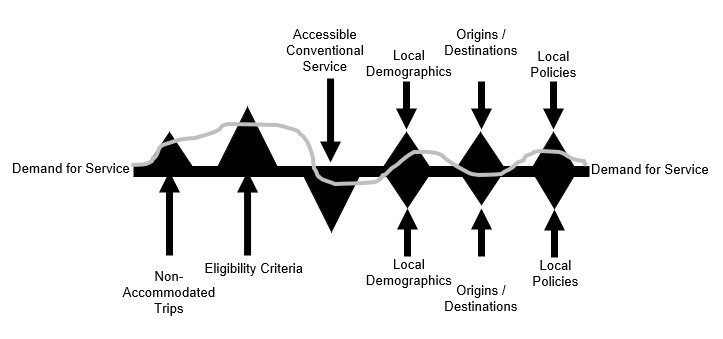
When attempting to estimate the demand for specialized services, there are a number of key factors that must be taken into consideration, all of which can vary in influence over time. These factors include:
- the number of trips the current service is unable to accommodate as requested. These trips are referred to as non-accommodated trips.
- the eligibility criteria for the specialized service, noting given requirements under AODA legislation, expanded criteria will be required in London to include those individuals with temporary disabilities.
- the level of accessibility of the conventional transit service offered. This includes accessible buses and stops and amenities as well as the areas of the city the service covers. This also includes the extent to which the service provider has implemented programs to encourage specialized transit customers to utilize accessible conventional service when possible as well as the level of service integration that exists between the conventional and specialized services.
- local demographics including but not limited to factors of age, disability, income etc.
- the location of key origins and destinations within the city and their proximity to one another. This includes senior homes, hospitals, rehabilitation facilities, medical offices etc., all of which tend to be primary origins and destinations for specialized transit customers.
- local policies and practices with respect to accessible transportation services including but not limited to the availability of accessible taxis.
- hospital policies with respect to outpatient treatments, dialysis unit scheduling and demand etc. noting these policies may be influenced by senior government program funding.
The following image depicts the impacts of the aforementioned factors on the level of demand for specialized services, noting at any point in time the magnitude of the impacts is subject to change, and as such, determining the level of demand for the specialized service is not a one-time event, but rather an ongoing exercise.
Non-Accommodated Trips
The manner in which the demand for specialized service is estimated is to measure the number of trips that could not be accommodated on the date and time which they were originally requested. These trips are referred to as “non-accommodated” trips. Adding these trips to the total number of trips provided will provide an estimated trip demand for a given time period. This measure provides an estimate based on the current registrant base for the service. The other aspect of estimating demand is the anticipated growth in registrants for the service, noting with each registrant added there is an accompanying need for access.
LTC measures non-accommodated trips by day, and summarizes same by month, and then by year. The daily non-accommodated trips can also be further broken down by time of day. This information is relied upon when making service enhancements or adjustments, in order to ensure that service is being provided during the periods of highest demand.
When preparing annual budgets and service plans, consideration is also given to the anticipated growth in registrants, which can be impacted by a number of factors.
Given that both conventional and specialized services are public transit services, delivered on a first come, first served basis, the rate of one non-accommodated trip per registrant per year is relatively low. In comparison, if the conventional transit service ceases to operate in an area of the city in the late evening, this results in a loss of transit access for customers residing in the affected area.
Level of Conventional Service Accessibility
By the end of 2012, London Transit’s conventional fleet was 100% low-floor accessible, and all stops in the city that have adjoining sidewalk infrastructure and no impeding barriers were also accessible. This milestone provided the opportunity for service integration between the conventional and specialized services. It also resulted in many more specialized trips being able to be accommodated on the conventional service, which in turn resulted in a corresponding decrease in demand, most notably in the period of April through November when snow and weather is not a barrier.
Other Influencing Factors
As indicated earlier, there are many other local influencing factors that can impact the demand for specialized service. The most significant factor in London over the past number of years, which is anticipated to continue in the foreseeable future, is the demand associated with customers who are dialysis patients. These customers generally require treatment three times per week (approximately 300 trips annually). Demand of this nature is anticipated to continue to grow as the population ages.
Determining Demand
Each year, the Accessible Public Transit Service Advisory Committee determines a performance target with respect to the level of non-accommodated trips it deems to be reasonable. This process was paused during the global pandemic, but re-initiated in 2024. In Early 2025, the booking/scheduling system for the specialized service was replaced, and as such, data from the first four months of the year was not tracked. The table below sets out the actual results for 2025. As set out in the graph, the significant investment in service hours over the past three years has resulted in significant improvements in the non-accommodated trip rate.
Non-Accommodated Trip Rates – 2025
| Total Trips | Average Daily Trips | Average Daily Non-Accommodated | |
| May | 30,396 | 1,073 | 7 |
| June | 28,669 | 1,054 | 6 |
| July | 29,920 | 1,137 | 23 |
| August | 29,059 | 1,150 | 12 |
| September | 31,222 | 1,233 | 65 |
| October | |||
| November | |||
| December |
APPENDIX VI – STEPS TO REDUCE WAIT TIMES FOR SPECIALIZED TRANSPORTATION SERVICES
Specialized transit customers in London have identified on-time performance as their highest priority in terms of the service in every customer survey completed. As such, trip assigners place a significant emphasis on this when creating the daily schedules for service, ensuring there is adequate time for drivers to complete their daily schedule on time. However, given the number of mitigating factors that can influence service each day, it is not possible to guarantee that every trip will be delivered on time.
For the purposes of this report, wait times for specialized transportation services will be defined as the period between the scheduled time for pick-up and the actual time of pick-up. In London, this measure is tracked based on any trip with a pick-up that is greater than 30 minutes past the scheduled pick-up time, and is defined as a “pick-up over 30 minutes”.
Each year the Accessible Public Transit Service Advisory Committee establishes a target for the number of pick-ups that will be in excess of 30 minutes past their scheduled time. As with the other targets, this process was placed on hold during the global pandemic, but re-introduced in 2024. Given the service is a shared-ride service, there are a number of factors that can influence performance against this target, many of which are not within the control of London Transit. These factors include, but are not limited to the following:
- traffic conditions, which can be significantly influenced by weather conditions, construction, delays caused by trains, accidents, etc.
- designated drop-off location issues (i.e. cars parked in designated drop off locations) which result in delays in dropping customers currently on-board the vehicle
- customers not being ready for their pick-up (i.e. dialysis patients not ready to leave, late medical appointments, etc.) which result in delays that can impact the rest of the day
- customers who do not take their scheduled trip, and don’t cancel it (i.e. no-show trip) noting the policy is that drivers will wait 5 minutes past the scheduled pick-up time before leaving the pick-up location
Given the only way to ensure trips are provided on schedule (or reduce wait times) is to leave room in the schedule to allow for unforeseen delays, trip assigners must be careful not to leave so much time that will result in other trips being non-accommodated and an ultimately inefficient service. The new scheduling/booking system implemented in 2025 has provided for greater scheduling features, which has resulted in improved on-time performance. The table below sets out the on-time performance for 2025 beginning in May when the new system was fully implemented.
On-Time Trip Performance (within 30 minutes of Schedule)
| May | Jun | Jul | Aug | Sep | Oct | Nov | Dec |
| 98.7% | 99.5% | 99.2% | 99.7% | 99.3% |
APPENDIX VII – PROCEDURES TO ADDRESS EQUIPMENT FAILURES
Fleet requirements are determined based on the number of vehicles required during peak operating times, plus those that will be subject to required inspections and maintenance. This is referred to as the spare fleet ratio. This ratio can vary significantly given factors such as the age and make-up of the fleet noting that while older buses may require higher levels of maintenance to keep them running efficiently, newer buses tend to have more electronics and features that are subject to failure.
There are a number of steps taken on a daily basis in an attempt to mitigate in-service break downs, including the following:
- Daily bus defect reports are turned into the garage by the Operator at the end of the day for follow-up by maintenance before buses are re-deployed.
- Every evening when buses are serviced (refueled, fare box emptied, etc.), employees also check that features of the bus appear to be in working order. In the event that an issue is discovered, the bus is either repaired that evening, or removed from service the following day until it can be repaired.
- Each day, prior to a bus leaving the garage for service, the Operator completes a “circle check”, ensuring that the vehicle is functioning properly, this check includes the various accessibility features on the bus (ramp, kneeling feature, tie downs, etc.). Should any features be found to not be in working order, the Operator will attempt to have it repaired prior to going into service. If the bus cannot be repaired in time, an alternate bus is assigned to the Operator.
While the aforementioned steps should mitigate in-service breakdowns, they do not eliminate them. When a bus defect disables the bus while in service, the following steps are taken:
- The bus Operator contacts dispatch and relays the defect information.
- The Dispatcher determines the extent of the defect and whether the bus can be repaired in service.
- If the bus defect can be repaired in service, dispatch contacts the mobile mechanic and co-ordinates a timely repair.
- If the defect cannot be repaired in service, dispatch contacts maintenance who arrange for a replacement bus.
- If the bus cannot remain in service, the bus is taken out of service and a replacement bus is dispatched.
It should be noted that the procedures set out above may be impacted by severe weather or other vehicle issues that may result in the inability to replace all buses experiencing difficulty in service (i.e. severe winter conditions may impact the functionality of the ramp or kneeling features of the bus).